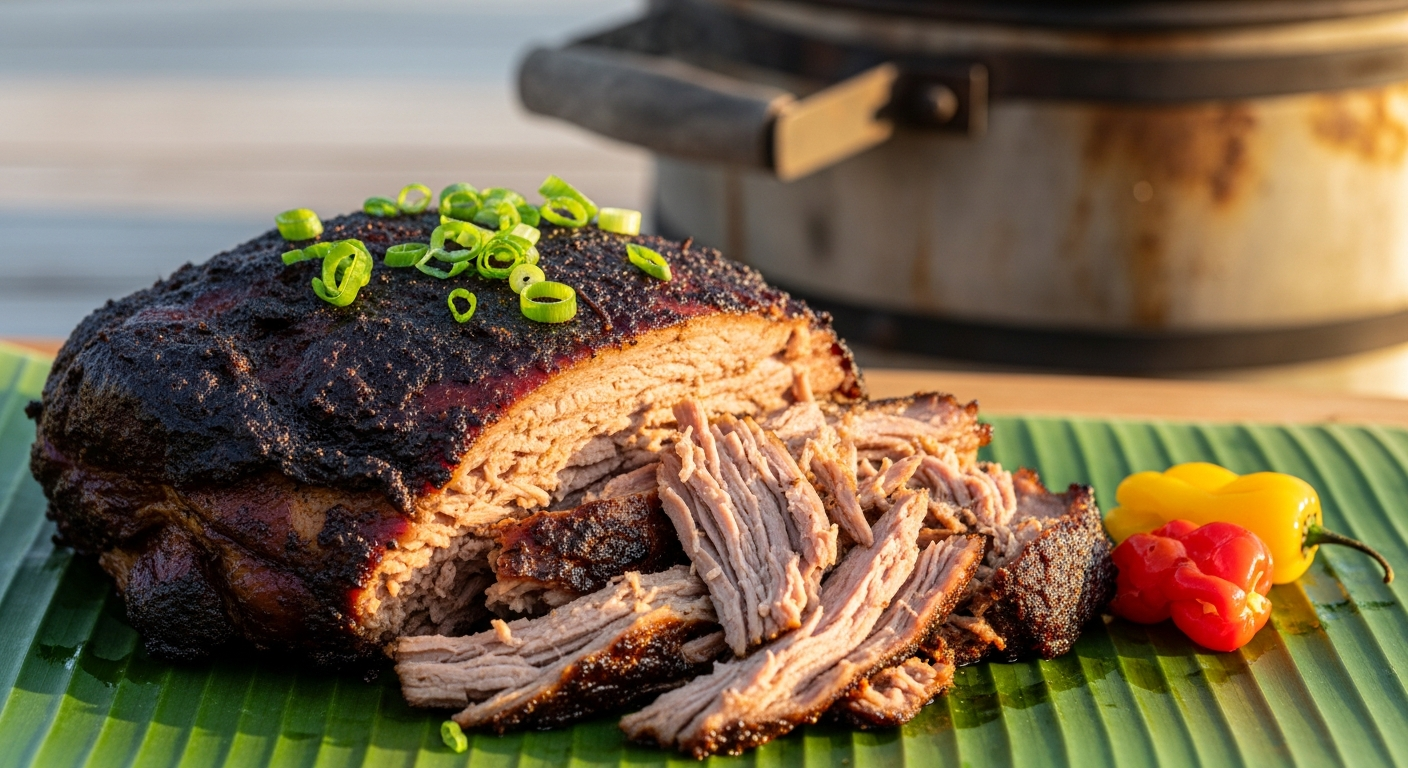
Jerk Pork Shoulder: The Ultimate Guide to the Original Cut
Pork shoulder is the definitive cut for authentic Jamaican jerk pork — high fat marbling, deep collagen, and the structural resilience to absorb two days of marinade. This guide covers injection technique, marinating windows, grill setup, and the 195–205°F pull temperature that separates tender jerk from chewy jerk.
Why Pork Shoulder Is the Definitive Jerk Cut
Pork shoulder — sold as Boston butt, pork butt, or picnic shoulder depending on the exact section — is the foundation of authentic Jamaican jerk pork. The Maroons who developed jerk cooking in the Blue Mountains were hunting and cooking wild boar, a tough, well-worked animal requiring the patience of low-and-slow fire cooking. Shoulder replicates that muscle profile: high collagen, heavy marbling, and dense muscle fibers that transform with time and heat into extraordinarily moist, pullable meat.
The fat cap on a pork shoulder serves a second purpose in jerk cooking: it carries the scotch bonnet, allspice, and herb flavors deep into the interior muscle as it renders during cooking. No other cut does this. Pork loin is too lean — it dries before flavor penetrates. Pork chops are too thin — they're done in 12 minutes. Shoulder gives you 6–10 hours at temperature for the marinade to become part of the meat.
Choosing the Right Shoulder Cut
Pork shoulder comes in two sections. The Boston butt (upper shoulder) has more intramuscular marbling and a thicker fat cap — it's the better choice for jerk, producing richer pulled pork with more even moisture throughout. The picnic shoulder (lower, includes the hock) has more connective tissue and skin — excellent for smoking whole but trickier to manage on a standard grill. For home cooks, the boneless Boston butt (4–8 lbs) is the most practical: consistent marbling, easy to inject, and fits in most grills and ovens.
Bone-in shoulder adds cooking time but produces more flavor in the final meat — the marrow contributes gelatin and depth. If you choose bone-in, add 30–45 minutes to estimated cook time and use a leave-in probe thermometer to track temperature.
Jerk Marinade for Pork Shoulder
Pork shoulder requires more marinade than chicken by volume because of its density. A standard ratio for a 6-lb boneless shoulder: 6–8 scotch bonnets (seeded for moderate heat, unseeded for authentic fire), 8 allspice berries toasted and ground, 6 garlic cloves, 4 green onions, 3 tablespoons fresh thyme, 2 tablespoons dark rum or coconut vinegar, 2 tablespoons soy sauce, 1 tablespoon brown sugar, 1 teaspoon cinnamon, ½ teaspoon nutmeg, 1 teaspoon freshly ground black pepper, juice of 2 limes. Blitz to a coarse paste — you want texture, not a smooth liquid.
Score the shoulder deeply before marinating: cuts 1–1.5 inches deep, spaced 2 inches apart, down to the bone where possible on bone-in cuts. Rub the marinade aggressively into every scored channel. This is the only way surface marinade reaches the interior on a large cut. See the complete jerk marinade recipe for full ingredient ratios and variations.
Injection Technique
For shoulders over 4 lbs, marinade injection is essential. A good marinade injector allows you to push liquid marinade into the geometric center of the cut — an area no surface application can reach regardless of marinating time. Thin the paste marinade with 2 tablespoons apple juice or pineapple juice before injecting to allow it to flow freely through the needle. Inject at multiple points (every 2 inches) at different depths, slowly withdrawing the needle while depressing the plunger to distribute marinade throughout the tunnel.
The result of injection is dramatically more even flavor throughout the shoulder — the interior tastes just as developed as the bark exterior. Without injection, a 6-lb shoulder will have 1–2 inches of deeply flavored exterior surrounding a relatively plain center.
Marinating Times
Pork shoulder marinating windows: minimum 12 hours, ideal 24–48 hours, maximum 72 hours. Beyond 72 hours, the acid in the lime juice begins to break down the surface protein, producing a mushy texture on the outer layer. The ideal window is 24–36 hours in the refrigerator, covered tightly. Remove from the refrigerator 45–60 minutes before cooking to bring the meat closer to room temperature — this promotes more even cooking and reduces the time needed on the grill or in the smoker.
Cooking Methods
Charcoal grill (indirect): Bank coals to one side. Place shoulder fat-cap-up on the cool side, cover, and maintain 250–275°F by adjusting vents. Add soaked pimento wood chips or chunks every 45 minutes. Cook 90 minutes per pound as a starting estimate. Mop with diluted jerk cooking sauce every hour from the 3-hour mark onward.
Smoker (offset or pellet): Set to 250°F. Use pimento wood for authentic Jamaican character — see our pimento wood guide for sourcing. Add wood every 45–60 minutes on an offset. Pellet grills maintain smoke automatically. Wrap in butcher paper at 165°F internal temperature to push through the stall, then unwrap for the final 30 minutes to re-form the bark.
Oven: Roast covered at 300°F for 4–6 hours, then uncovered at 425°F for 25 minutes to caramelize the exterior. The oven method produces exceptional flavor from the marinade alone — the missing element is wood smoke, which can be partially approximated with smoked salt and a small amount of liquid smoke in the marinade.
Pull Temperature and Resting
Pork shoulder for pulling should reach 195–205°F internal temperature. At the USDA-safe minimum of 145°F, shoulder is safe to eat but dense and impossible to pull apart — collagen has not yet converted to gelatin. The additional cooking from 145°F to 195°F is purely for texture. Use a reliable instant-read or leave-in probe thermometer to track temperature accurately. The "probe test" is a secondary check: at 195–205°F, a probe thermometer should slide into the thickest part of the shoulder with zero resistance, like inserting into room-temperature butter.
Rest the shoulder for a minimum of 30 minutes and ideally 45–60 minutes tented loosely in foil before pulling. Resting allows the muscle fibers to reabsorb the juices that migrated toward the surface during cooking. A shoulder pulled immediately after removing from heat will release the majority of its juices onto the board — a properly rested shoulder retains them in the meat.
Serving and Pairing
Pulled jerk pork shoulder works across multiple formats. Traditional Jamaican: serve over white rice or rice and peas with fried sweet plantain and festival bread. Sandwich format: pile on a brioche bun with vinegar-dressed Jamaican coleslaw and a drizzle of jerk cooking sauce. Bowl format: sliced or pulled pork over coconut rice with black beans, mango salsa, and lime crema. The richness of shoulder means it pairs especially well with acidic accompaniments — lime-dressed coleslaw, pickled scotch bonnets, or a side of fresh mango salsa.
For drinks, a cold Red Stripe lager is the classic Jamaican pairing — the bitterness cuts the fat and scotch bonnet heat cleanly. A rum punch or ginger beer both work for non-beer drinkers.
Frequently Asked Questions
Frequently Asked Questions
How long does jerk pork shoulder take to cook?
Should I use bone-in or boneless pork shoulder for jerk?
What is the stall in pork shoulder cooking?
Can I cook jerk pork shoulder in a slow cooker?
How much jerk pork shoulder per person?
Editorial Selection
Recommended Products
Marinade Injector
EssentialBest for: Pork shoulder, Boston butt
Essential for large pork shoulder — pushes jerk marinade into the center of the cut.
Why we recommend it: Without injection, the interior of a 6-lb shoulder tastes plain regardless of marinating time.
Affiliate link coming soonLeave-In Probe Thermometer
Best for: All large cuts
Monitors shoulder temperature through the long cook without opening the grill lid.
Why we recommend it: A shoulder at 185°F pulls poorly; at 205°F it pulls like butter. Only a probe thermometer tracks this accurately.
Affiliate link coming soonPimento Wood Chips
Best for: Smoking pork shoulder
Authentic Jamaican allspice wood for smoking — cannot be replicated by any other wood.
Why we recommend it: Pimento wood produces the specific aromatic smoke that defines Boston Bay jerk pork flavor.
Affiliate link coming soonEditorial note: These are independent recommendations based on quality and usefulness for jerk cooking. We may earn a small commission if you purchase through our links — at no extra cost to you. See our affiliate disclosure for full details.
Free Newsletter
Get Authentic Jerk Recipes Delivered
Authentic Jamaican recipes, cooking tips, and new guides delivered to your inbox. No spam — unsubscribe any time.
No spam. Unsubscribe anytime.
Complete Guide
Jamaican Jerk Pork: Complete Guide
Everything you need to know about this topic in one comprehensive guide.
Read the complete guide →Continue Learning
Authority Guides
Related Topics
Recipes & Techniques
Written by
Jerk Cuisine Specialist
Marcus Thompson has spent over a decade studying Jamaican culinary traditions, from the jerk pits of Boston Bay to home kitchens across the Caribbean diaspora.
View full bio