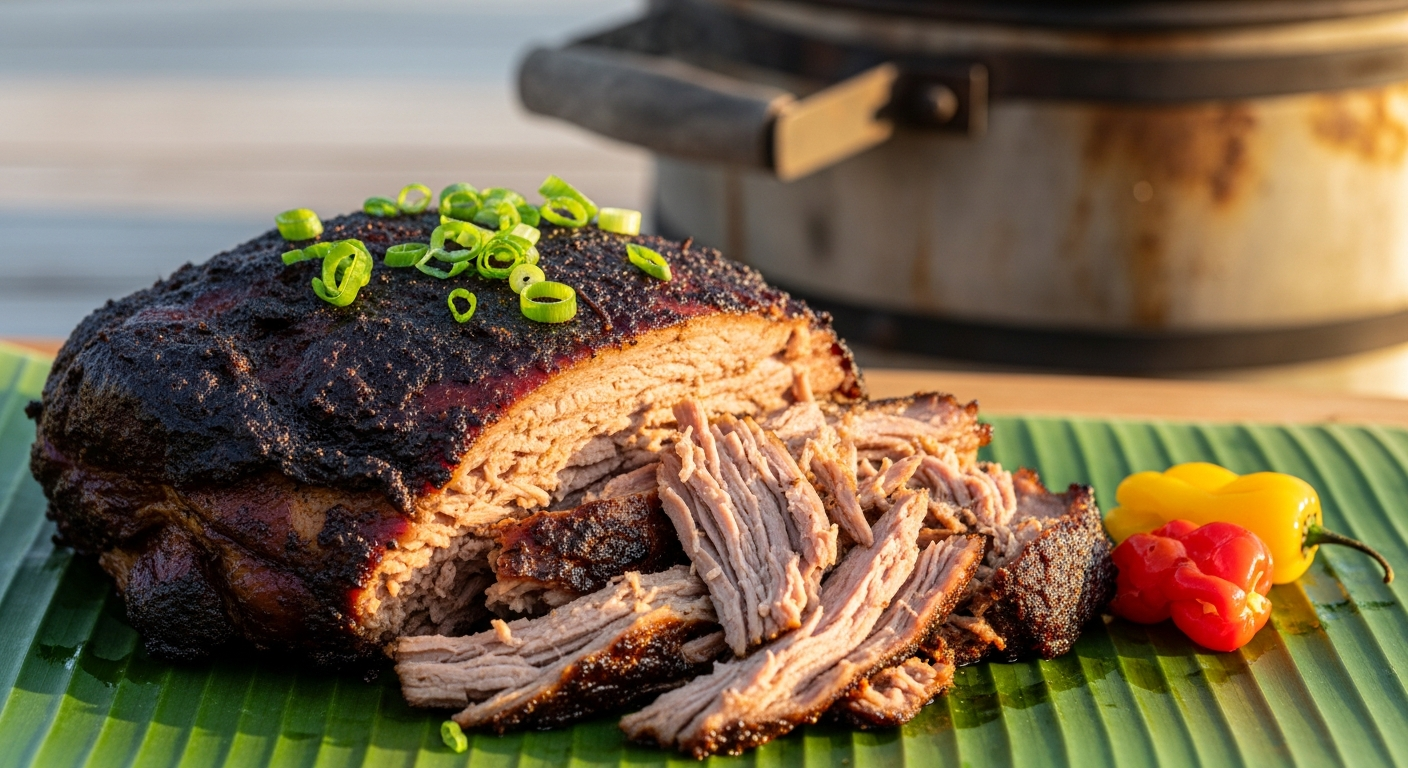
Smoked Jerk Pork: Wood, Temperature, and the Boston Bay Method
Smoked jerk pork is where authentic Jamaican jerk tradition meets modern low-and-slow technique. Pimento wood smoke — the same allspice wood used in Boston Bay for centuries — transforms a jerk-marinated shoulder into something that combines the scotch bonnet spice of the marinade with the aromatic depth of real Jamaican wood smoke.
The Critical Importance of Wood Selection
In traditional Jamaican jerk cooking — particularly at the Boston Bay pit stalls that defined the style — pimento wood is not optional. It is integral to the flavor. Pimento wood comes from the allspice tree (Pimenta dioica), and when burned, it releases a smoke that is itself aromatic with allspice, clove, and bay leaf notes. This smoke compounds the allspice berries already in the jerk marinade, creating a layered flavor profile that no other wood can replicate.
Outside Jamaica, pimento wood is harder to source but increasingly available online — see the pimento wood buying guide for reliable suppliers. Secondary options if pimento wood is unavailable: apple wood (mild, slightly sweet, doesn't compete with scotch bonnet), cherry wood (slightly sweet, good color), or a blend of apple and a small amount of mesquite (no more than 20% mesquite — too much overpowers the jerk spice). Avoid pure hickory or pure mesquite — their intensity dominates the scotch bonnet and allspice in the marinade, producing BBQ flavor rather than authentic jerk flavor.
For allspice berries sourcing and background, see the complete allspice guide.
Smoker Setup for Jerk Pork
Target smoking temperature: 225–250°F. At 225°F, a 6-lb pork shoulder takes 9–11 hours. At 250°F, 7–9 hours. Both produce excellent results — 225°F gives more time for smoke penetration and a more prominent smoke ring; 250°F is more practical for a day-long cook. Stabilize the smoker temperature before adding meat — most offset smokers need 45–60 minutes to reach and hold temperature. Pellet grills stabilize faster (15–20 minutes).
Water pans: placing a pan of water in the smoker chamber maintains ambient humidity, which promotes bark formation (moisture on the surface captures smoke particles) and prevents the outer muscle from drying before the interior reaches temperature. Replace the water when it evaporates — typically every 2–3 hours on an offset smoker.
For equipment recommendations, see the smoker buying guide and the charcoal grill guide for setups that can function as indirect smokers.
The Stall and How to Handle It
The "stall" is inevitable when smoking large pork shoulder at low temperatures. The internal temperature will plateau at approximately 150–170°F for 1–4 hours. This is caused by evaporative cooling — moisture evaporating from the surface of the meat cools it at the same rate the smoker heats it. First-time cooks panic and raise the smoker temperature, which produces a dry, rushed result.
Two approaches to the stall: (1) Push through naked — do nothing. Maintain smoker temperature and wait. The stall will eventually break as the surface dries and evaporation decreases. This produces the most pronounced bark and deepest smoke flavor. Adds 1–3 hours to total cook time. (2) Wrap at the stall (Texas Crutch) — when the temperature plateaus at 165°F, wrap the shoulder tightly in butcher paper or foil. The trapped steam carries temperature through the stall quickly. Unwrap for the final 30 minutes to re-crisp the bark. Faster and more predictable, but the bark is slightly softer than the naked method.
The Boston Bay Method
At the famous Boston Bay jerk stalls in St. Thomas parish, Jamaica, the method is different from anything in this guide: fresh pimento wood (green, uncured) cut into thick logs, arranged in a pit or open grill, burned down to coals, then pork is placed directly on a grate over the embers. The pimento wood coals and the fresh green wood logs produce smoke simultaneously — there is no temperature control device, no probe thermometer, and no wrap. The cook monitors by touch, color, and smell, adjusting the wood arrangement as needed. The result after 6–8 hours is the benchmark of jerk pork — charred, smoky, spiced, and irreducible by description.
The closest home approximation: use a charcoal kettle grill with 1/3 chimney of charcoal plus pimento wood chunks, arranged for indirect cooking at 250–275°F. Replenish both charcoal and pimento wood every 45–60 minutes. The higher heat relative to a dedicated smoker is offset by more active wood smoke and more direct radiant heat — closer in character to the open-fire Boston Bay method.
Finishing and Resting
Remove the shoulder from the smoker at 195–205°F internal temperature. Wrap tightly in butcher paper (foil traps steam and softens the bark — paper breathes while retaining heat). Rest in a cooler or oven at 150°F for 30–60 minutes before pulling. The resting period allows the internal juices to redistribute — a shoulder pulled immediately after removing from the smoker will lose 20–30% of its moisture onto the cutting board. After resting, pull by hand into the three textures described in the pulled jerk pork guide.
Frequently Asked Questions
Frequently Asked Questions
What wood is used for authentic Jamaican jerk smoking?
How long to smoke jerk pork shoulder?
How do I set up a kettle grill for smoking jerk pork?
Do I need a water pan when smoking jerk pork?
Is smoked jerk pork better than grilled jerk pork?
Editorial Selection
Recommended Products
Pimento Wood Chunks
Most AuthenticBest for: All smoked jerk pork
The authentic Jamaican smoking wood — the single biggest differentiator in smoked jerk flavor.
Why we recommend it: Pimento wood smoke is aromatic with allspice, clove, and bay — it compounds the marinade rather than competing with it.
Affiliate link coming soonOffset Smoker
Best for: Large shoulder cooks
Best for Boston Bay-style jerk pork — wood fire with dedicated firebox and cooking chamber.
Why we recommend it: An offset smoker with pimento wood is the closest home equivalent to Boston Bay pit cooking.
Affiliate link coming soonEditorial note: These are independent recommendations based on quality and usefulness for jerk cooking. We may earn a small commission if you purchase through our links — at no extra cost to you. See our affiliate disclosure for full details.
Free Newsletter
Get Authentic Jerk Recipes Delivered
Authentic Jamaican recipes, cooking tips, and new guides delivered to your inbox. No spam — unsubscribe any time.
No spam. Unsubscribe anytime.
Complete Guide
Jamaican Jerk Pork: Complete Guide
Everything you need to know about this topic in one comprehensive guide.
Read the complete guide →Continue Learning
Authority Guides
Related Topics
Buying Guides
Written by
Jerk Cuisine Specialist
Marcus Thompson has spent over a decade studying Jamaican culinary traditions, from the jerk pits of Boston Bay to home kitchens across the Caribbean diaspora.
View full bio