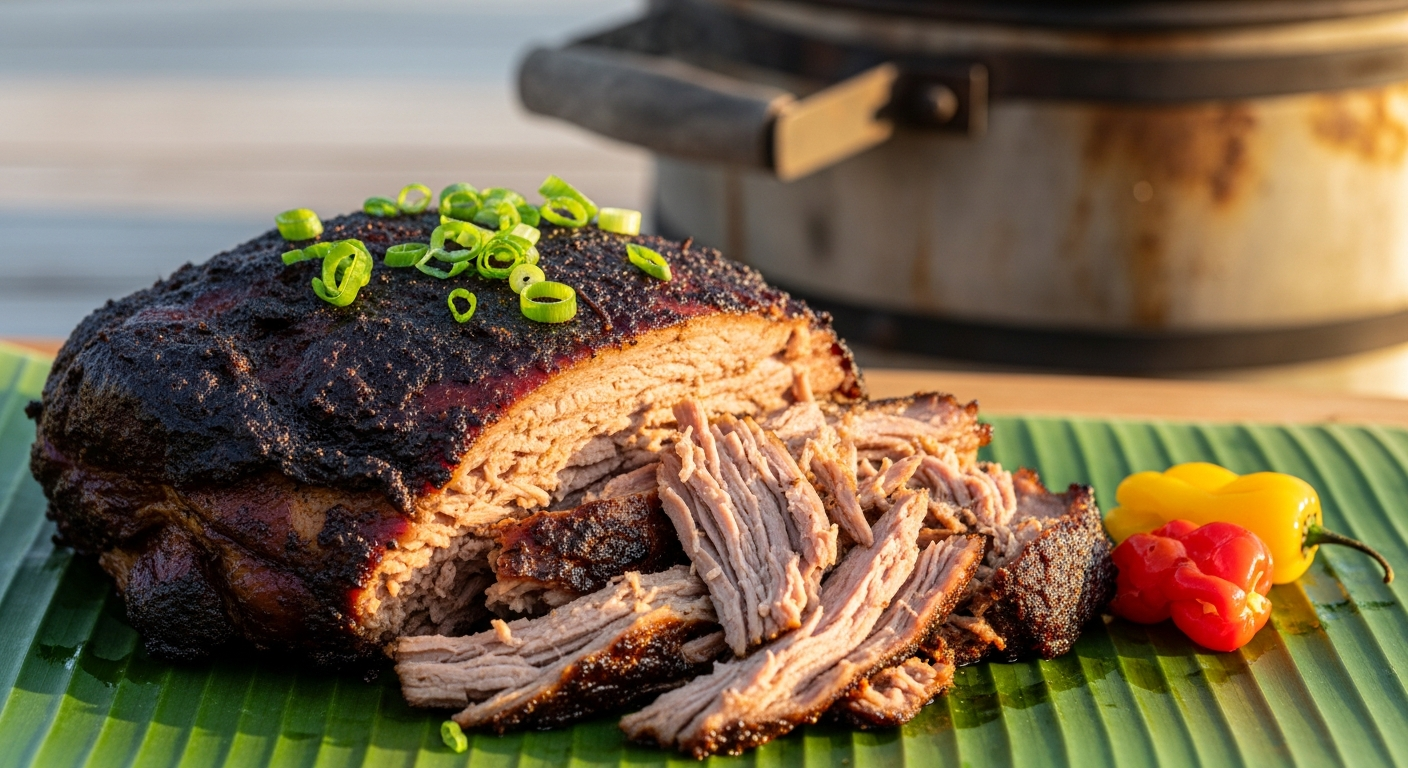
Before there was jerk chicken, there was jerk pork. The Maroons of Jamaica — the free Africans who built independent communities in the island's mountains starting in the 1650s — hunted wild boar and cooked it over pimento wood fires, seasoned with the two ingredients that defined their local landscape: allspice berries and scotch bonnet peppers.
Jerk pork is historically the original jerk. Today it remains a special-occasion centerpiece in Jamaica — the protein you cook for Christmas, for large family gatherings, for serious cookouts. It takes more time than chicken, requires a bit more knowledge, and rewards patience with extraordinary results: deeply smoky, fiery, rich, fall-off-the-bone pork that no other cooking tradition produces.
This guide covers everything about jerk pork: which cuts to buy, how to build the marinade, how long to marinate, every cooking method with temperatures and times, and how to serve it.
⚡ Quick Facts — Jerk Pork
🇯🇲 Why This Guide Matters
Jerk pork is the most undercooked (in the culinary sense) topic in Caribbean food guides, which almost universally focus on chicken. But pork is historically the more significant protein — and the cooking principles are meaningfully different. The temperature targets, marinating times, and handling of different cuts all diverge from chicken. This guide gives jerk pork the dedicated coverage it deserves as the original Jamaican jerk protein.
Why Jerk Pork Is the Original
The Maroons who developed jerk cooking were subsistence hunters in the Jamaican interior. Wild boar (Sus scrofa), feral descendants of pigs brought by Spanish colonizers in the late 15th century, populated the mountains and forests where Maroon communities lived. Boar was the most available large protein — far more so than domesticated chicken or cattle.
The jerk technique — deeply seasoning and slow-cooking pork in a covered pit over pimento wood — was specifically developed for this protein. The heavy spicing preserved the meat in the tropical climate. The slow pit cooking tenderized the tough, lean wild boar muscle. The pimento wood smoke added a layer of complexity and also had some antimicrobial properties.
When the Maroon cooking tradition spread to the broader Jamaican population over the 18th and 19th centuries, domesticated pork replaced wild boar — but the technique and the flavors remained the same. Boston Bay jerk stalls, which emerged as informal commercial operations in the early 20th century, centered on pork first. The chicken came later.
Related: complete history of Jamaican jerk cooking, Maroon history and jerk cooking.
Best Cuts of Pork for Jerk
Pork Shoulder (Boston Butt) — Best Overall
The pork shoulder is the ideal cut for jerk pork. It has significant intramuscular fat marbling and a high collagen content from connective tissue. When cooked low-and-slow (250–275°F for 6–10 hours), the collagen converts to gelatin, the fat renders, and the result is extraordinarily moist, rich, easily-pulled pork that is saturated with jerk flavor.
Best cooking methods: Smoking (best), oven (good), slow cooker (excellent for shredded)
Weight: 6–10 lbs is ideal (bone-in for more flavor)
Cook time: 6–10 hours at 250°F in smoker; 6–8 hours on low in slow cooker
Target temp: 195–205°F internal
Pork Ribs — Best for Grilling
Spare ribs and St. Louis-cut ribs are excellent for jerk. The combination of rendered fat, caramelized jerk marinade, and bone-adjacent flavor makes jerk ribs extraordinary.
Best cooking methods: Smoker (best), oven (very good), charcoal grill with indirect heat
Cook time: 3–5 hours at 250°F (3-2-1 method: 3 hours unwrapped, 2 wrapped in foil, 1 unwrapped for crust)
Target: Probe slides in with no resistance; meat pulls back from bones by ¼ inch
Bone-In Pork Chops — Best for Quick Cooking
Thick-cut (1–1½ inch) bone-in pork chops are excellent for jerk grilling — the bone contributes flavor and slows down overcooking. Marinate 12–24 hours, sear over direct heat 4–5 minutes per side, finish indirectly to 145°F internal.
Pork Tenderloin — Best for Speed
The leanest cut and the one most prone to overcooking. Marinate 4–6 hours maximum (acid will compromise texture with longer marinating), cook at high heat (400°F oven or direct grill), pull at 145°F. Quick and good, but the least rich and forgiving of the pork options.
| Cut | Best Method | Marinate | Target Temp | Why Choose It |
|---|---|---|---|---|
| Pork shoulder (bone-in) | Smoker, oven | 24–48 hrs | 195–205°F | Richest, most traditional, best for crowds |
| Spare ribs | Smoker, charcoal | 12–24 hrs | ~195°F / pull test | Spectacular jerk bark and bone flavor |
| Bone-in pork chops | Charcoal/gas grill | 12–24 hrs | 145°F | Fast, great grill marks, individual servings |
| Pork tenderloin | Oven, grill | 4–6 hrs | 145°F | Quickest, leanest, most delicate |
Jerk Marinade for Pork
The base jerk marinade works beautifully on pork — but there are specific adaptations that produce better results for the denser, fattier protein.
Standard Jerk Pork Marinade
Start with the base marinade from our complete jerk marinade guide, then make these pork-specific adjustments:
- Add 2 tbsp pineapple juice or fresh pineapple — bromelain (pineapple's natural enzyme) tenderizes pork proteins more effectively than citrus acid alone. Particularly valuable for shoulder and ribs.
- Increase allspice to 2 tsp — pork carries more fat, which can mute spice notes. Slightly more allspice ensures the backbone of the flavor comes through.
- Add 1 tbsp dark rum — molasses-like depth from dark rum complements pork fat beautifully. Use Appleton Estate or J. Wray & Nephew.
- Increase soy sauce to 4 tbsp — the extra umami and salt penetration compensates for the denser, less absorbent pork muscle compared to chicken.
Related: jerk marinades for pork — tips and variations, jerk marinades for chicken, pork, and fish.
Marinating Time and Technique
Scoring
Score pork even more aggressively than chicken. For pork shoulder: use a sharp knife to cut 2-inch deep slashes in a crosshatch pattern across all surfaces. For ribs: make cuts between each bone and through the membrane on the bone side (or remove the membrane entirely). The denser pork muscle requires more pathways for the marinade to penetrate.
Injection (for large cuts)
For pork shoulder (6+ lbs), injection is strongly recommended. Thin the marinade with equal parts lime juice and water, then inject into the center of the muscle in multiple locations. This ensures interior flavor regardless of how long the surface marinates. Space injection points 1–1.5 inches apart across the full surface.
Marinating Times
| Cut | Minimum | Ideal | Maximum |
|---|---|---|---|
| Pork shoulder (6–10 lbs) | 8 hours | 24–48 hours | 72 hours |
| Spare ribs / baby back ribs | 6 hours | 12–24 hours | 36 hours |
| Bone-in pork chops | 4 hours | 12–24 hours | 36 hours |
| Pork tenderloin | 2 hours | 4–6 hours | 8 hours |
Grilling Jerk Pork
Pork Chops on the Charcoal Grill
- Build a two-zone charcoal fire; add allspice berries or wood chips to the coals
- Sear bone-in chops over direct heat, 4–5 minutes per side
- Move to indirect zone, cook 10–15 more minutes at 325–350°F until 145°F internal
- Rest 5 minutes before serving
Ribs on the Charcoal Grill
Use indirect heat only. Set up coals on one side, place ribs on the other. Add wood chips every 30 minutes. Cook at 300–325°F for 3.5–4.5 hours. Baste with jerk cooking sauce in the last 30 minutes. Wrap in foil for 1 hour if ribs seem dry at the 2-hour mark.
Smoking Jerk Pork
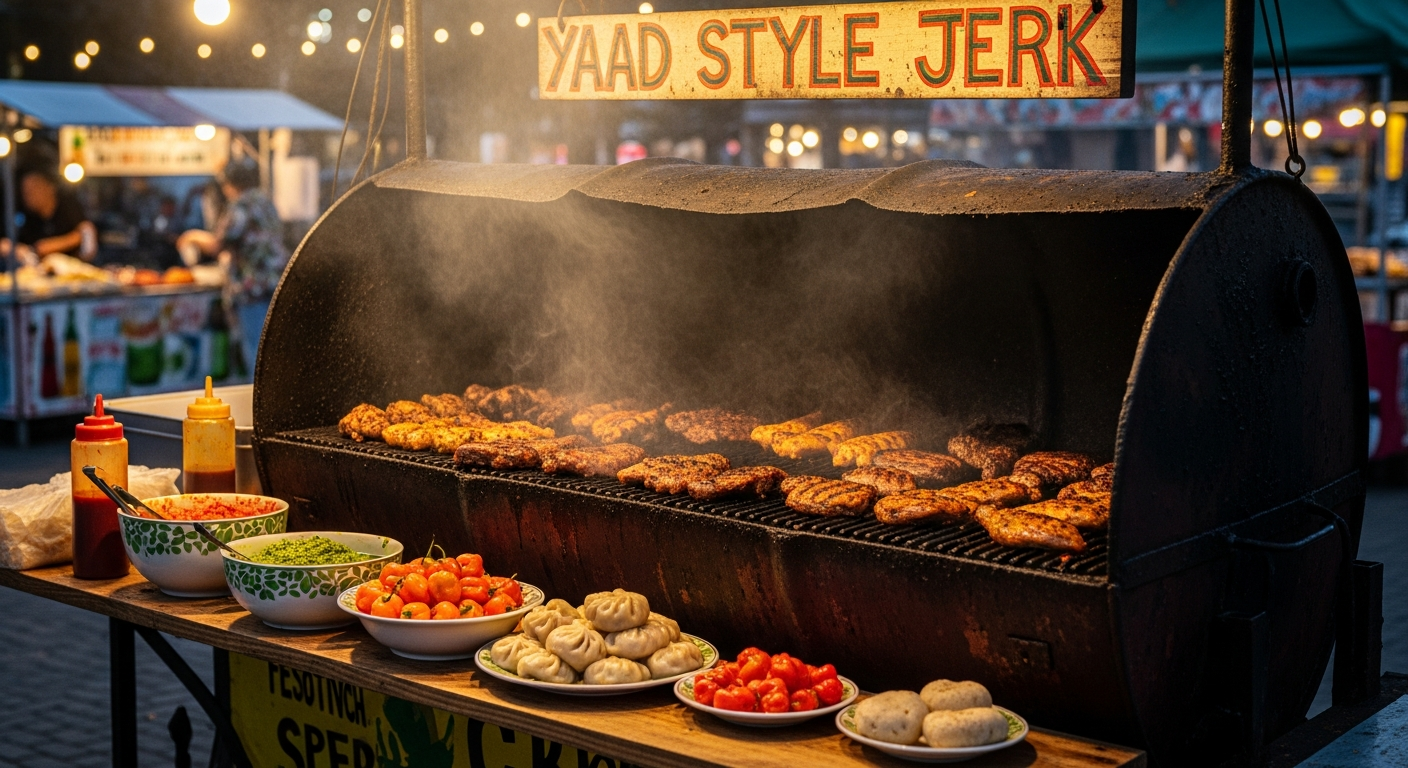
Smoking is the most authentic cooking method for jerk pork shoulder — it replicates the traditional pit cooking closest to what Boston Bay stalls and Maroon tradition produced.
Pork Shoulder in the Smoker
- Set smoker to 250°F with cherry, apple, or allspice wood chips
- Place marinated shoulder fat-side up on the grate
- Smoke 6–10 hours (estimate 1.5 hours per pound) until internal temp reaches 195–205°F
- Wrap in butcher paper or foil when internal temp stalls around 165°F (the "stall" — protein water evaporating) to power through; this usually takes 1–2 hours
- Rest in a cooler wrapped in towels for 1 hour before pulling
Result
A deep smoke ring through the first ¼ inch of meat. A thick, spiced bark on the exterior. Extraordinarily moist, tender pork that pulls apart with fingers. The combination of jerk marinade and cherry wood smoke is one of the most complex flavor profiles in any cooking tradition.
Oven-Roasted Jerk Pork
Pork Shoulder in the Oven
- Preheat to 325°F
- Place marinated shoulder in a Dutch oven or roasting pan with a lid (or cover tightly with foil)
- Roast covered for 3–4 hours until 180°F internal (still sliceable)
- Remove cover, raise oven to 425°F, roast 30–45 more minutes until deeply caramelized and internal temp reaches 195°F
- Rest 30 minutes before pulling or slicing
Pork Ribs in the Oven
- Preheat to 300°F
- Place ribs meat-side up on a foil-lined baking sheet, cover tightly with foil
- Bake 2.5–3 hours
- Remove foil, raise to 400°F, baste with jerk cooking sauce
- Bake uncovered 20–25 minutes until caramelized
Slow Cooker Jerk Pork
Slow cooker jerk pork shoulder produces exceptional, effortless results — particularly for shredded jerk pork used in sandwiches, rice bowls, and tacos.
- Score and marinate pork shoulder 24–48 hours
- Add to slow cooker with ½ cup jerk cooking sauce + ¼ cup chicken broth + 1 sliced onion
- Cook on LOW 8–10 hours or HIGH 5–6 hours until meat is falling apart
- Shred with two forks; remove excess liquid, reserve for drizzling
- For a crust: spread shredded pork on a baking sheet, broil 4–5 minutes until edges crisp
Serve over coconut rice with coleslaw and fried plantain. Related: jerk pork vs jerk chicken — comparison guide.
Internal Temperatures
| Cut | Safe Temperature | Optimal Temperature | Why |
|---|---|---|---|
| Pork shoulder (for pulling) | 145°F (safe) | 195–205°F | Must render collagen for tender, pullable texture |
| Pork shoulder (for slicing) | 145°F (safe) | 170–185°F | Sliceable, still moist; less tender than pulled |
| Ribs | 145°F (safe) | 195–203°F | Probe slides through with no resistance; meat pulls back from bone |
| Bone-in chops | 145°F | 148–155°F | Slight pink inside at 145°F is safe and preferred; 155°F if nervous |
| Tenderloin | 145°F | 145–150°F | Dry and tough above 155°F — pull early, rest |
Serving Jerk Pork
Jerk pork in Jamaica is served similarly to jerk chicken — with rice and peas, festival, fried plantain, and coleslaw. The richer fat content of pork means it pairs particularly well with:
- Vinegar-based coleslaw (not creamy) — the acid cuts through pork fat more effectively
- Pineapple or mango slices — fruit acid and sweetness against the richness
- Pickled scotch bonnet peppers — heat and acid together are perfect with fatty pork
- Rice and peas — always; the coconut milk tempers the heat
- Festival — the sweetness directly balances the spice and richness
Related: complete jerk side dishes guide, best sides for jerk pork dinner, what to serve with jerk pork.
Common Mistakes
- Not scoring deeply enough — pork shoulder is 4–6 inches thick. Surface slashes don't reach the interior. Score aggressively and inject for large cuts.
- Stopping at 145°F for shoulder — safe temperature is not the optimal texture temperature. Shoulder needs 195–205°F to break down collagen and become tender. Trust the thermometer and keep cooking.
- Cooking ribs too fast — high heat makes ribs tough and dry. Low-and-slow at 250–300°F is the only way to tenderize the collagen-rich rib meat without drying it out.
- Skipping the rest — a pork shoulder needs 30–60 minutes of rest after cooking. The internal temperature continues to rise, and the juices redistribute. Cutting immediately causes all the moisture to run out.
- Forgetting the fat cap — for pork shoulder, score the fat cap (the thick layer of exterior fat) deeply before marinating. The scored fat allows the marinade to penetrate rather than sitting on an impermeable fat layer.
Related Guides on JerkPit.com
- Jerk Marinade Recipe — Complete Guide
- Jerk Marinades for Pork
- Jerk Pork or Jerk Chicken — Which Is Better?
- Complete Jerk Cooking Methods Guide
- Smoking vs Grilling Jerk Meats
- Jerk Marinades for Chicken, Pork, and Fish
- Best Sides for Jerk Pork Dinner
- What to Serve With Jerk Pork
- Complete History of Jamaican Jerk
- Maroon History and Jerk Cooking
- Jerk Seafood Guide
- Complete Jerk Side Dishes Guide
🍴 Chef's Tip — Score Before You Marinate
The single most impactful technique improvement for jerk pork: score deeply before marinating. For pork shoulder, use a sharp knife to cut 1-inch deep scores through the fat cap and into the meat every 2 inches across the entire surface. This does two things — it allows the marinade to penetrate far deeper than surface marinating alone, and it creates channels for rendered fat to escape during cooking, improving the exterior crust. For pork chops, score the fat cap around the edge to prevent curling during cooking.
Continue Learning: Jerk Pork Deep Dives
Compare
Ultimate Jerk Chicken Guide
See how jerk chicken technique compares — most principles overlap.
Every Method
Jerk Cooking Methods Guide
Charcoal, smoker, oven, air fryer, slow cooker — complete temperature charts.
The Origin
History of Jamaican Jerk
Why pork was first — the Maroon history that explains jerk's origins.
Complete the Meal
Complete Jerk Side Dishes Guide
Rice and peas, festival, plantain — build the full jerk pork spread.